

*TLDR* Below is a filled in example to guide you and at the end of the post you can download the blank template.
When you take charge of your first section/platoon, establish what you consider to be the baseline and what going above and beyond looks like. This should be included in your initial counseling with your Marines and in your introduction with the platoon.
Should we be extrinsically motivated by awards? Absolutely not. However, recognition or a pat on the back makes a big difference. It means “I see you’re going the extra mile, you’re an example to follow.” If we treat everyone the exact same way regardless of their performance level then the platoon will never strive for the next tier. Recognizing your top performer demonstrates to the group that hard work is seen and is impactful.
If no one in your platoon is willing to go the extra mile:
- are you setting the right example with your own performance?
- does the environment/culture stifle growth?
- have you given them the opportunity to succeed?
- are you challenging them enough?
Below is an example and template you can use next time you’re writing an award. Plan on minimum submitted the award 30 days prior to awarding it. Talk to your S1 about submission timelines.
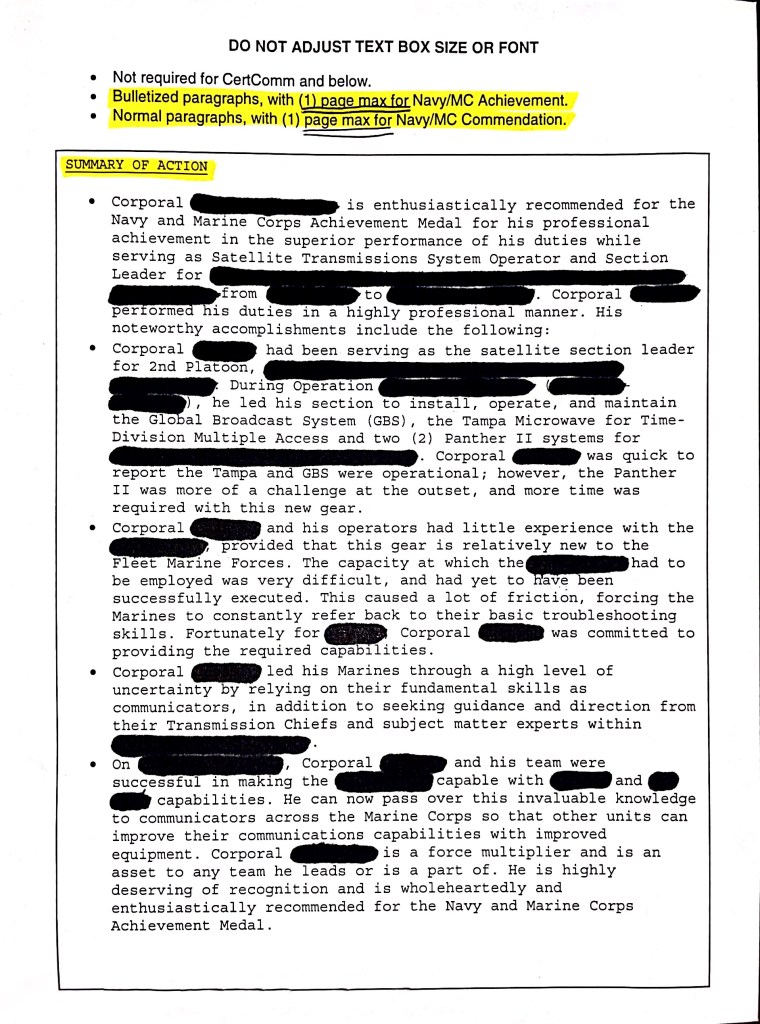
- Start with your Summary of Action
– For a NAM or MC, this should be about the length of a page. This will be part of the submission package on IAPS. If the voting board is unsure on the level of award, they will scrub the summary of action to see if it is appropriately commensurate with the award.
– Avoid fluff. If you don’t have enough material then it likely isn’t worthy of an award. Be to the point. Use concrete quantifiable examples and data that can show anyone, regardless of MOS, that the Marine’s work was impactful. Show how it affected the bigger picture – the company, battalion, regiment, squadron, etc. These should be accomplishments outside of their billet expectations.
– Use words like “led,” “planned,” “successfully accomplished the mission ahead of time,” “influenced peers and subordinates,” “performed above his/her rank,” “without LCpl Smith’s hard work and ingenuity the unit would have failed to complete the mission on time,” etc.
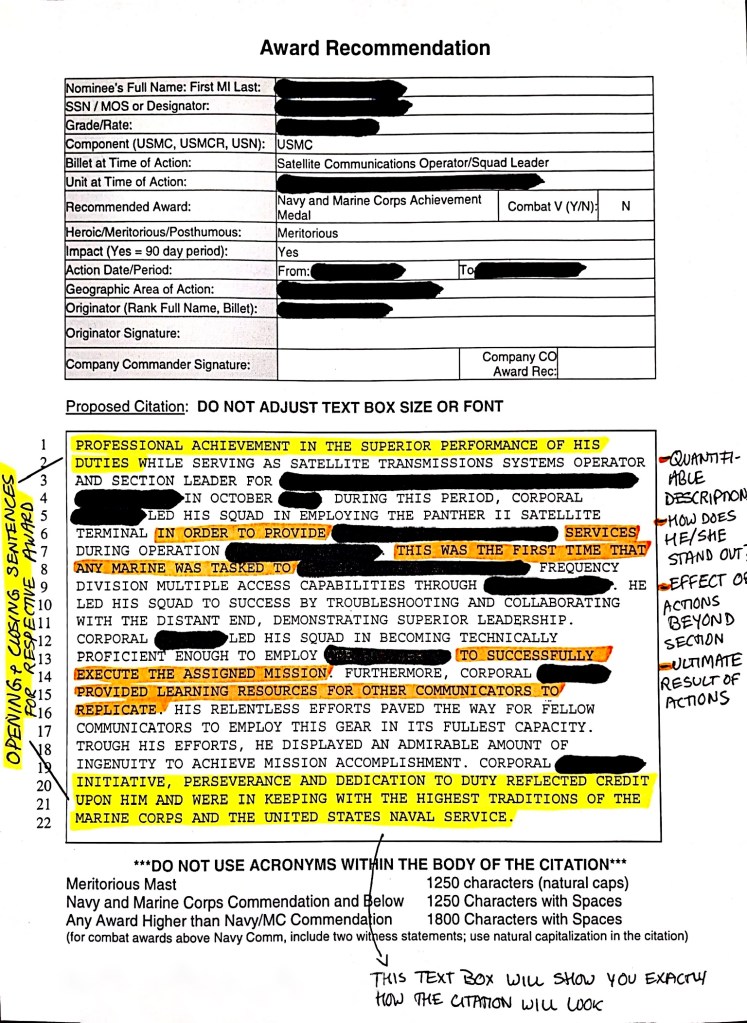
2. Draft the Citation:
– Once you have a solid and reviewed summary of action (your platoon staff and senior enlisted advisor should review it and give feedback), you can start crafting the citation. Take the most impactful actions, look up the appropriate award opening and closing sentences, and you’ve got yourself an award.
– Prior to submitting it all on IAPS, have staff review your citation as well. If you’re submitting supporting evidence make sure it all lines up with the summary of action.
3. Awards Process:
– Depending on your command’s routing process it can now take up to a month to get it fully processed (this is usual for a NAM/MC, for anything higher or lower times vary – consult with your S1). Once the award is assigned to a board, the voting members can reach out and ask for more clarifying information or they can directly vote for a lower level award. Keep an eye on the comments. Some of these misinterpretations can be resolved with a quick face-to-face conversation. Fight for your dudes. Once the board has convened/voted and your command deck has concurred with all votes, the award will be fully processed by the S1. Make sure you’re staying in touch so you can appropriately plan the awards ceremony.
4. Your award got denied now what? No reason for a pity party. Don’t give up easily, but if you have fought for the award and the command is not on the same page with you, start looking at alternatives:
-implement weekly or monthly recognitions for the platoon (warrior of the month)
-Make your own engraved plaque that gets handed down to top performers when warranted
-Cert Comms/LOAs/Meritorious Mast are usually faster to process and are rarely turned down by company staff
-You don’t even need to do anything fancy to acknowledge the hard work of your top Marine. Before securing the platoon take some time to recognize those who have gone above and beyond and how their actions have impacted the unit as a whole. A simple shout out in front of peers can go a long way.
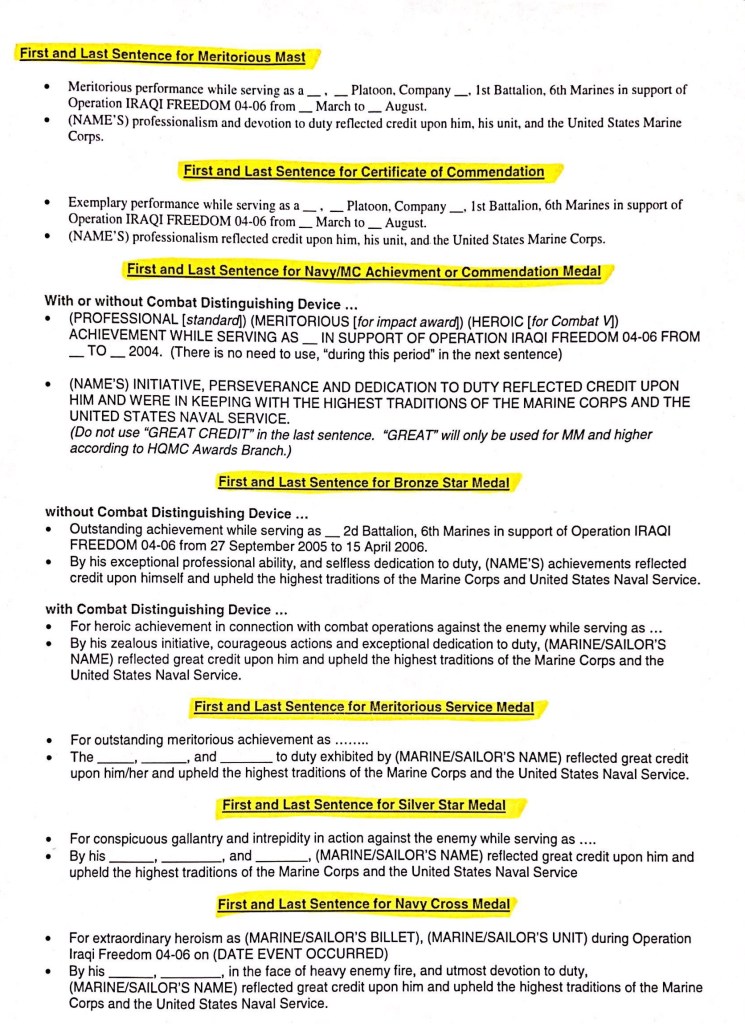
Below is the blank template file for you to use. Remember, different commands require specific formats, this is simply to use as a guide so you know how much you need to write out.
 Expeditionary Leader
Leave a comment